Dugald Stewart by Emanuele Levi Mortera
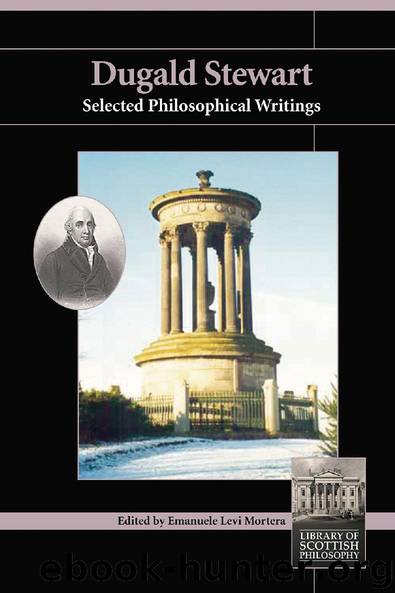
Author:Emanuele Levi Mortera
Language: eng
Format: epub
Tags: Dugald Stewart, University of Edinburgh, Republic of Letters, Scottish philosophy, Common Sense School, philosophy, logic, inductive logic, mathematical axioms, knowledge, causation, lews of belief, deity, God, attention, abstraction, association of ideas, perception, free will, agency, freedom, taste, politics, political economy, progress, conjectural history, history
ISBN: 9781845403980
Publisher: Andrews UK Limited 2012
Published: 2012-03-15T00:00:00+00:00
* * *
[T]he assent we give to the conclusion of a syllogism does not result from any examination of the notions expressed by the different propositions of which it is composed, but is an immediate consequence of the relations in which the words stand to each other. The truth is, that in every syllogism the inference is only a particular instance of the general axiom, that whatever is true universally of any sign, must also be true of every individual which that sign can be employed to express. Admitting, therefore, that every process of reasoning may be resolved into a series of syllogisms, it follows that this operation of the mind furnishes no proof of the existence of anything corresponding to general terms, distinct from the individuals to which these terms are applicable.
These remarks, I am very sensible, do by no means exhaust the subject, for there are various modes of reasoning to which the syllogistic theory does not apply. But in all of them, without exception, it will be found, on examination, that the evidence of our conclusions appears immediately from the consideration of the words in which the premises are expressed, without any reference to the things which they denote. The imperfect account which is given of deductive evidence, in the received systems of logic, makes it impossible for me, in this place, to prosecute the subject any farther.
After all that I have said on the use of language as an instrument of reasoning, I can easily foresee a variety of objections which may occur to the doctrine I have been endeavouring to establish. But, without entering into a particular examination of these objections, I believe I may venture to affirm, that most, if not all, of them take their rise from confounding reasoning or deduction, properly so called, with certain other intellectual processes which it is necessary for us to employ in the investigation of truth. That it is frequently of essential importance to us, in our speculations, to withdraw our attention from words, and to direct it to the things they denote, I am very ready to acknowledge. All that I assert is, that in so far as our speculations consist of that process of the mind which is properly called reasoning, they may be carried on by words alone; or, which comes to the same thing, that every process of reasoning is perfectly analogous to an algebraical operation. What I mean by “the other intellectual processes distinct from reasoning, which it is necessary for us sometimes to employ in the investigation of truth”, will, I hope, appear clearly from the following remarks.
In algebraical investigations, it is well known that the practical application of a general expression, is frequently limited by the conditions which the hypothesis involves, and that in consequence of a want of attention to this circumstance, some mathematicians of the first eminence have been led to adopt the most paradoxical and absurd conclusions. Without this cautious exercise of the judgment, in the interpretation
Download
This site does not store any files on its server. We only index and link to content provided by other sites. Please contact the content providers to delete copyright contents if any and email us, we'll remove relevant links or contents immediately.
The remains of the day by Kazuo Ishiguro(9083)
Tools of Titans by Timothy Ferriss(8490)
Giovanni's Room by James Baldwin(7433)
The Black Swan by Nassim Nicholas Taleb(7195)
Inner Engineering: A Yogi's Guide to Joy by Sadhguru(6835)
The Way of Zen by Alan W. Watts(6670)
The Power of Now: A Guide to Spiritual Enlightenment by Eckhart Tolle(5854)
Asking the Right Questions: A Guide to Critical Thinking by M. Neil Browne & Stuart M. Keeley(5831)
The Six Wives Of Henry VIII (WOMEN IN HISTORY) by Fraser Antonia(5557)
Astrophysics for People in a Hurry by Neil DeGrasse Tyson(5224)
Housekeeping by Marilynne Robinson(4504)
Double Down (Diary of a Wimpy Kid Book 11) by Jeff Kinney(4332)
12 Rules for Life by Jordan B. Peterson(4331)
Ikigai by Héctor García & Francesc Miralles(4310)
The Ethical Slut by Janet W. Hardy(4307)
Skin in the Game by Nassim Nicholas Taleb(4306)
The Art of Happiness by The Dalai Lama(4167)
Skin in the Game: Hidden Asymmetries in Daily Life by Nassim Nicholas Taleb(4051)
Walking by Henry David Thoreau(3999)
